

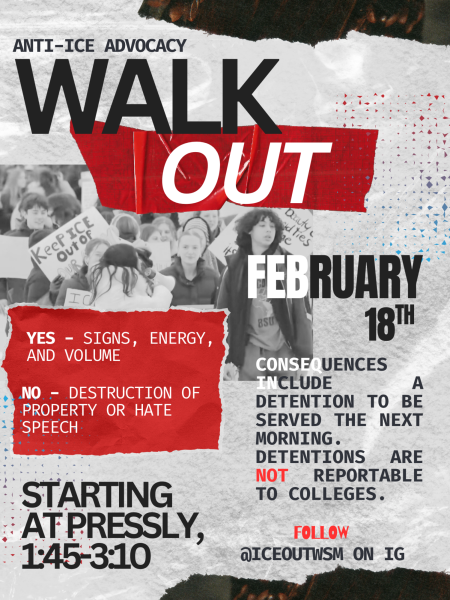
 About 30 Upper School students faced academic consequences after walking out of class on Wednesday, Feb. 18 in protest of Immigration and Customs Enforcement (ICE) agents’ presence in Atlanta.
Students were motivated to voice their concerns about the potential for danger in their community when ICE agents arrived in Atlanta. 11th graders Brij Vyas, Zari Preyor, and Ismini Vasiloglou believed that people needed to get vocal about issues in our country, especially in places like the Upper School, where people might be hesitant to speak politically.
Preyor, Vasiloglou, and Vyas started a GroupMe to gain interest for a walkout. After amassing roughly 300 members, they talked with Head of Upper School Chanley Small and Upper School Dean of Students Brooks Batcheller about the consequences of walking out of class so that the GroupMe members knew what they would face. “We felt like it was important to us that we gave everyone the truth so they knew what they were getting into,” Vyas says.
Small said she told the students the standard consequences of missing class. “If you cut class—and a walkout is a class cut because you’re not in class—you get a detention,” she says. “If you are missing work, then you get a deduction when you make up that work. So if you did lab work in class or if you took a test, your maximum grade is going to be a 70 because you didn’t take that test in the appropriate time period. That is not a punishment for the walkout. It is standard policy for any class cut.”
Small also made sure the students knew their goals and the impact of a protest in the community. “[Batcheller and I] talked about both their goals and what some potential drawbacks of this approach would be,” she says. “[We asked ourselves,] ‘Would this approach create divisiveness in the community? What happens when a different group decides to walk out with views that differ from your views?’”
On the day of the walkout, the students first gathered in front of Pressly Hall before walking around Barge and then the campus road loop back around to the Hawkins-Campbell area, continuing to walk the loop for roughly 45 minutes.
Vyas maintained that any chants were positive. “After talking with Dr. Small and Mr. Batcheller, we knew that cursing, all kinds of profanities, saying any slurs—which I would hope no one would—saying anything really demeaning and negative was something that we wouldn’t tolerate,” he says. “So I think it was good because we were able to criticize something without being atrociously negative about it in how we were speaking about it and how we were going about it.”
According to 10th grade participant DF Chalmers, the walkout gave students a chance to express their dismay. “Some people shared statistics about the situation with [what] ICE is doing, facts, and specific stories about the situation in America right now,” they said.
Frank Brown, Director of DEI and Community Engagement, believes that students should be allowed to find their political voice. “As a school, one of the responsibilities that we have as adults is to try to help students find their voice and to develop a critical lens about the world around them,” he says. “If they just see something that, to them, feels like it requires a response, we want to make certain that we’re providing them the agency to be able to do so. That could be with regard to protests or different forms of responses to things that are occurring in the world.”
However, Director of the Glenn Institute Meghan James cautions that protest alone isn’t the answer. “I don’t know that two protests would be the best solution [to political disagreement],” she says. “I think [a better approach would be] a civil dialogue-type situation where we’re inviting people to first learn from each other.”
Small, while understanding some students’ desire to protest, wants them to use existing Upper School programs to address conflict. “My preference on campus is that we’re using venues like [Civil Dialogue Fellows] where they do reading beforehand, they’re trained in how they’re going to talk about an issue,” Small says. “Then they can agree to disagree. They’re not trying to win the argument.”
Nonetheless, James maintains that a Civil Dialogue Fellows’ luncheon is not the best mode of discussion for this topic. “The piece about [Civil Dialogue Fellows] that I think is a little bit difficult is especially when it’s a topic that could be as emotional and two-sided as ICE and trying to rely on our students to facilitate the conversations with not as much training as they need,” she says. “That’s the moment where it’s a civil dialogue, but it’s facilitated by a trusted adult versus a student.”
For his part, Vyas believes that the school needed a protest. “We felt like it was really important to do something physical because a lot of the time, Civil Dialogue Fellows, especially with the luncheons that they have, [is] very much something that’s contained, and a lot of people who aren’t invited to the Civil Dialogue luncheons [don’t] even know about it.”